Showing posts with label Extra Credit. Show all posts

Thursday, December 8, 2016

Back up and Review

Back up and Review
Week 15
. . .
(Quote from Author Louisa May Alcott)

. . .

     This motivational quote was my favorite part of this week's class announcements because I have been going through more health problems lately and I am not particularly religious so I can only really look to proverbs or sayings to give me more motivation. Part of having medical problems is being happy you found something wrong because you have a way to treat such a thing but when you are in the limbo of not understanding what is wrong with you, it is really easy to lose hope.
    That is why this quote means a lot to me. Right now I am afraid because I do not have the word storms to put to my problems they are nameless things that have no cure because of their vague symptoms. But to at least have this quote is to say that at least I will know how to treat myself by the end of this scary time for me. That might be too much self-disclosure for a simple blog post but I also was not expecting there to be a perfectly fitting quote to be in the class announcements. Either way, I am grateful for the boost of energy I gained from what was probably just supposed to be a simple quote. 


. . .

Famous Last Words: Dead Week

Famous Last Words
Dead Week
. . .
(Dead Week Cartoon by Rosalie M.)
. . .

     This week has been the worst dead week I have ever had in my undergraduate classes. I could list all the unexpected life problems I have had that have stopped my academic courses this semester alone but honestly I am just ready to move past this week and have time to get my life together without immediately stressing about classes. What I really need for this break is to reevaluate what is important to me and how to get to those goals.
    I think earlier in the semester I took my life going well for granted so I did not put in as much work as I should have thinking I could wrap it in a nice bow near the end of the semester. But of course life stops for no one and I really did not want to take an I in any class or take medical leave with one and half semesters left. By figuring out what I really want and having a plan from the beginning I think will be able to at least have a list of all I need to get done so that way if life gets in the way I can just reprioritize the list instead of having to make one in the first place.
    I know this post was supposed to be about just this week but what I have learned is this week means nothing without the happenings of the weeks before. It is partly due to life problems but it is also the mannerisms and habits I established earlier in the semester that messed me up this fall. Ultimately, I cannot just forget about this week when it is done but I definitely will take a mental break then refocus myself for a better semester next time!  
. . .

Wikipedia Trails

Wikipedia Trails
. . .
(Enneagram Drawing)

. . .
Enneagram (Wikipedia)
The enneagram is a typing system I have been learning in my personalities course this semester and I have recently become obsessed with knowing anything and everything I can concerning the enneagram. But I realized I had never read the wikipedia page so I thought it could lead me on a fun trail! This page is actually pretty accurate to what I know about the enneagram is quite detailed on its history and the complexity of the system; it was a real treat to read what other contributors had posted about the enneagram.

The Law of Seven (Website)
This is a really interesting piece on a concept I had never heard of before: The law of seven concerning the enneagram. The law of seven is a really hard concept to grasp after reading through it about 5 times over, I still could not not pinpoint where this concept was coming from nor its actual relation to the enneagram. It is at this point that I saw a link that was set there to better explain such concepts. 

The Six Processes (Website)
As a person who loves learning new things and rarely gives up when a concept is not fully understood, I found myself dumbfounded at the material that was in this new link's piece. I think I have learned to skim rather than completely understand each link so that way I can find myself on a better pathway in the Wikipedia Trails. I think this is where I will stop for this wikipedia trails but I do have to say I am disappointed I did not look deeper into this option every week because it probably would have been my favorite project of the course.

. . .


Learning by H.E.A.R.T: Empathy

Learning By H.E.A.R.T: 
Empathy Collage
. . .


. . .

This is collage is a representation of what I think of when it comes to empathy. 

Growth Mindset: Multiple Intelligences

Growth Mindset: Multiple Intelligences 
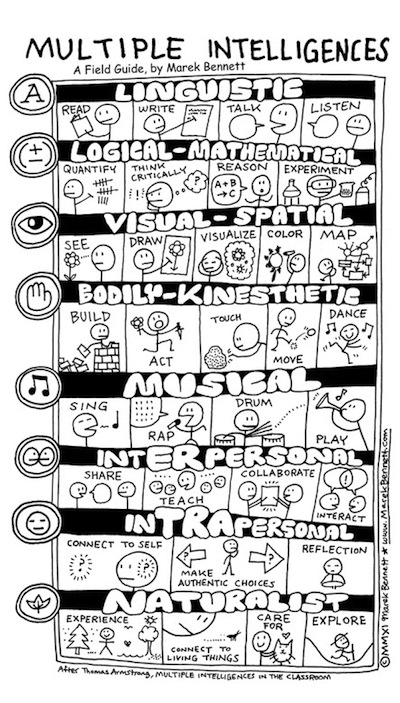
(Multiple Intelligences cartoon by Marek Bennet)
. . .

     This was a familiar idea concerning growth mindset for me because I am in a personalities course this semester and have found a new passion for personality psychology as a possible career path. I have taken the test for multiple intelligences a number of times and know where my strengths and weaknesses lie within this typing system. It is a system I feel like really helps me face a number of problems as well explains some of my natural tendencies. 
    My highest intelligences are musical, linguistics and kinesthetics, which is expected if you knew me well. What is exciting and helpful about knowing my strengths in these types of intelligences is that I can better go about my problems with a good plan. Like in studying, I know that I learn best in short time periods (because I cannot be stagnant for long) or at least in an environments where I can move around. I also know that rhymes or free associations help me memorize things better as well as group discussions where I can deep dive into subjects. 
    All of these strengths help me focus my work in the semester not just for academics but in how to spend my time and what will recharge me the most. Like listening to music and painting or reading or watching tv shows from other countries to get a sense of the language are all great ways from me to let go of mass amounts of stress. This was a great way to explore way to grow and better utilize my knowledge on multiple intelligences. 
. . .


. . .

Extra Reading Notes: The Ballads of Robin Hood

Reading Notes
. . .
(Robin Hood Character by Karem Beyit)

. . .
The Golden Arrow
I find that I really enjoyed the ballad formatting of the Robin Hood tales. As noted by my frequent postings of them poems are becoming my favorite type of creative writing and I always am fascinated on how many ways there are to tell a story especially while creating a melody to the ballad itself. With poems I have just started to write in more intricate rhyme patterns and this ballad showed how rhyme patterns can be twisted to be melodies instead.

Robin Hood and the Valiant Knight
This ballad was interesting because of the writing itself rather than the framework. For me, rhymes create a sense of anticipation as the reader goes onto the next line but even so, the story itself wasted no time creating itself own sense of urgency with the climatic battle. This ballad felt like it had everything a great story should have: mystery, action, dialogue, charm all wrapped up into a plot with a natural flow. 

Robin Hood's Death
What I find funny about folklore in general is how many ending one story can cultivate over time. For me, I have never actually read literature concerning robin hood past children's story books. I have only read fairytales and watched movies about him but reading this different ending in ballad form was a treat! Being able to find a new ending in any familiar piece of work is always fascinating, so I can appreciate the values of the ballads by comparing it to the children's books and movies I have seen before.

. . .

All reading notes are based off of excerpts from The English and Scottish Popular Ballads by Francis James Child (1882-1898).

Tech Tip: Create a Pinterest Board

Tech Tip: Create a Pinterest Board
. . .

       This tip was a interesting one for me, as I already use Pinterest occasionally for crafts or projects. This semester in particular has kicked my organizational/time management skills in the butt. While I have always had good organizational skills, I do not do well with unexpected complications that push back any plans I had. This semester has just been life problem after life problem, which lead to a complete obliteration of any organization or structure I had in my life. That's why as this semester comes to a bitter but much needed close, I wanted to create a board full of tips that I loved and have yet to try out so I can get back on track.
        Setting it up was easy enough, following the instructions laid out by Professor Gibbs as well as my common knowledge of the app. And then I just searched every kind of organization I needed back in my life. Starting with academic and online class organizational tips all the way to financial planners that might be useful to own. At first, just looking at others' organized "put together" lives, I was just discouraged but after a while I got excited by the different ideas I could implement now!
      Ultimately, I would recommend for others to try this out if they have a new goal they would like to reach or simply want to find a mecca for fun and creative ideas on anything. I would just be careful with the recreational pinning because it can easily become a distractor for some people. Overall, I think this is a neat tech tip that will help me get back to where I was and could be immediately great for others!

. . .

Monday, December 5, 2016

Tech Tip: Hashtags and Retweets

Tech Tip: Hashtags and Retweets
(Quoted tweet by @ChachiBobirks)
. . .
. . .

       This tip was a interesting one for me, in learning how to do it and testing it out. Usually, I would describe myself as a person who enjoys working under pressure. Not only do I feel like I work best, because I am required to be concise instead of indulging my want to elaborate, but I also just enjoy pressure to a certain extent. The downside of this leads to procrastination more often times than not, which is why I thought the timer might recreate that feeling but allow me to get it done earlier.
        Setting it up was easy enough, following the instructions laid out by Professor Gibbs, but the real test was to see if my idea held up. I tried it out Friday before class and ultimately, I think my strong sense of laziness prevailed. Rather than encourage me to get it done, my anxiety by constantly checking where I was on the timer lead me to want to give up all together than be slightly late on the timer. I definitely will still try this timer idea out until I can break this dangerous habit but as far as first tries go, this one was a failure on my part.
      Nonetheless, I would recommend for others to try this out if they have a knack for working under pressure, the timer does do a good job of recreating that sense of urgency other people like me enjoy. I would just be careful with the expectations you put on yourself with each timer you set. Don't push too far or you might be prone to just giving up instead of prevailing. Overall, I think this is a neat tech tip that may need some more toying with for me but could be immediately great for others!

. . .

Monday, November 28, 2016

Reading Notes: Dante's Inferno Part B

Reading Notes
The Giants
For this particular part, what I really enjoyed was the formatting or rather the continuation of the step by step theme that the journey through the rungs of the inferno ignited. By walking through each of the giants with small excerpts for each the staircase quality of the plot was able to thrive on. Out of the five giants we meet I latched onto Nimod. Whether that is because of the authors note or just the writing I am unsure but I think I am also attracted to the curse laid upon him. To lose the ability to communicate is a fate I would wish upon no one and can be such a source of pain that I was entranced by his cameo in the piece.

Ugolino
The story of Count Ugolino is a captivating one to say the least. For all intents and purposes, Ugolino was just a naive noble who paid for his foolishness in famine. Funnily Enough, I heard the story of Count Ugolino in an episode of a podcast called Lore; being slightly familiar with the piece allowed for a renewed pleasure in the reading for me. Instead of hearing a third party, Count Ugolino was able to describe his own demise which provided a fun, delicious (excuse the morbid pun) twist. 

Satan
The personification of Satan over time has evolved and twisted itself into a product of media culture. At first it was in the medium of books and novels, such as the bible and Dante's Inferno but with tv shows and movies the Devil has been shaped into a whole new beast of its own right. For me, it was intriguing to see and understand one of the first elaborate depictions of the Christian Satan. While every culture has their from of the Devil, Dante's Inferno's description is a thing of nightmares and maybe that is the key to his writing in general: to being people's sins and nightmares to the forefrront.

. . .

All reading notes are based off of excerpts from Dante's Divine Comedy, translated by Tony Kline (2002).

Monday, November 14, 2016

Tech Tip: Google Timer

Tech Tip: Google Timer
. . .

       This tip was a interesting one for me, in learning how to do it and testing it out. Usually, I would describe myself as a person who enjoys working under pressure. Not only do I feel like I work best, because I am required to be concise instead of indulging my want to elaborate, but I also just enjoy pressure to a certain extent. The downside of this leads to procrastination more often times than not, which is why I thought the timer might recreate that feeling but allow me to get it done earlier.
        Setting it up was easy enough, following the instructions laid out by Professor Gibbs, but the real test was to see if my idea held up. I tried it out Friday before class and ultimately, I think my strong sense of laziness prevailed. Rather than encourage me to get it done, my anxiety by constantly checking where I was on the timer lead me to want to give up all together than be slightly late on the timer. I definitely will still try this timer idea out until I can break this dangerous habit but as far as first tries go, this one was a failure on my part.
      Nonetheless, I would recommend for others to try this out if they have a knack for working under pressure, the timer does do a good job of recreating that sense of urgency other people like me enjoy. I would just be careful with the expectations you put on yourself with each timer you set. Don't push too far or you might be prone to just giving up instead of prevailing. Overall, I think this is a neat tech tip that may need some more toying with for me but could be immediately great for others!

. . .

Extra Reading Notes: Alice in Wonderland Part B

Reading Notes
The Mad Tea Party
This first part of one of my favorite portions of Alice in Wonderland marks the charm of two iconic characters: the Mad Hatter and the March Hare. Probably more so than Alice herself, the Mad Hatter is a cultural icon and his charming nonsensical sense has a level of escapism that I think, no matter the age, all people tend to seek out. Adversely, you have the March Hare overly concerned with time keeping the groundedness of reality well and alive.  

The Mad Tea Party (Part II)
This portion of the Mad Tea Party is truly a lesson in what fun dialogue can bring to a story. More often than not, it is easier to just write out a story not concerning one's self with any dialogue just making the character come alive based solely on description. But the charm of dialogue is that by writing in the character's voice the cadence of the character's words can do more for character building than a two paragraph long description. This rings true for the Dormouse in this scene, no real character description but the dialogue is enough to hold it up. 

The Mad Tea Party (Part III)
This ending always struck me as a lovely unfinished piece. There is no real conclusion with the Dormouse and his additions to Alice's adventures but it does nothing to dull the charm of the stories. As a reader I am not sure what Carroll did to pull this off. Was it his diligent world-building that let me accept this as a proper ending? Was it the character already being introduced fleetingly? Just goes to showcase Lewis Carroll's genius in writing.

. . .

All reading notes are based off of excerpts from Alice's Adventures in Wonderland by Lewis Carroll (1865).

Monday, November 7, 2016

Tech Tip: Canvas Notifications

Tech Tip: Canvas Notifications
. . .
(OU Canvas graphic for OU Insight website)
. . .

       This tip was really helpful for me in particular because admittedly, I think about this class last in my to do list that is ever growing as a senior. This course is also the only course I have that utilizes Canvas so there is a strong element of forgetfulness since I normally just check D2L. By learning how to set up notifications other than the reminders sent out by the instructor, I have added in an extra wall in defense of forgetfulness. 
       Another helpful aspect of setting up one's Canvas notifications is that it keeps me accountable. If I make the bad decision of relaxing with Netflix instead of doing the work that is due that night I get an extra reminder at 7 am through email to wake up and do all work within the grace period. Although, notifications do not combat against some of my bad habits or crazy class/work schedule the extra help does not hurt! 
      Even though we are nearing the end of the semester and most students are already on the right track assignment wise, I know that because of its online aspect this class will, unfortunately, be left not prioritized. By setting up notifications, it keeps this course in one's mind and high on the priority list or at the very least gives the student a nagging sensation until the assignment is completed. I really recommend students use this feature for this course and any upcoming classes they may have. You never know, one notification might just save your grade! 

. . .

Extra Reading Notes: British Fairy Tales (Emerson) Part A

Extra Reading Notes
. . .
(The first of the five photographs shows Frances Griffiths with the alleged fairies By Elsie Wright)
. . .


The Fairies of Caragonan
What I really found interesting and appriecated the most from this short story is the format and flow. Rather than the story itself, I was more intrigued by the three act, almost play like format. In addition, the actual flow of the story was very different from American fairy tales because instead of starting at the beginning (when/why the hunter got sick in the first place) it started with his cure by the fairies then went back to tell his tale.

The Fairies of Caragonan (Part II)
The continuation of the previous story provided a nice, bow-wrapped ending to a fairly peculiar fairytale. From other mythologies that involve fairies, I have known fairies to be more trickster, selfish characters yet in this telling they willing helped a hunter save his ill-fated life. Admittedly, I was kind of waiting for the other shoe to drop as read on. If I were to rewrite this story I would definitely add the trickster element.

Three Short Stories of Fairies 
I loved how with this Emerson story was a collection of three seemingly connected stories. Oddly enough, after each story I found myself wanting more and got that answered with the next story even though they are not originally connected. As for the first story when the blacksmith ended up with the money, I immediately wanted there to be a fable about the importance of cherishing money and in the next story a farmer gained a lesson in just that.

The Old Man and the Fairies

This second collection of short stories was more of what I am used to when I think of fairies. I think of the fairies having conditions for any riches they give out and holding true to them. The theme of conditional riches is deeply seeded in many different folklores but I feel as though the most impactful are usually those of the trickster variety, like Anansi, Loki and the fairies of this story.

. . .

All reading notes are based off of stories from Welsh Fairy-Tales and Other Stories by Peter H. Emerson (1894).